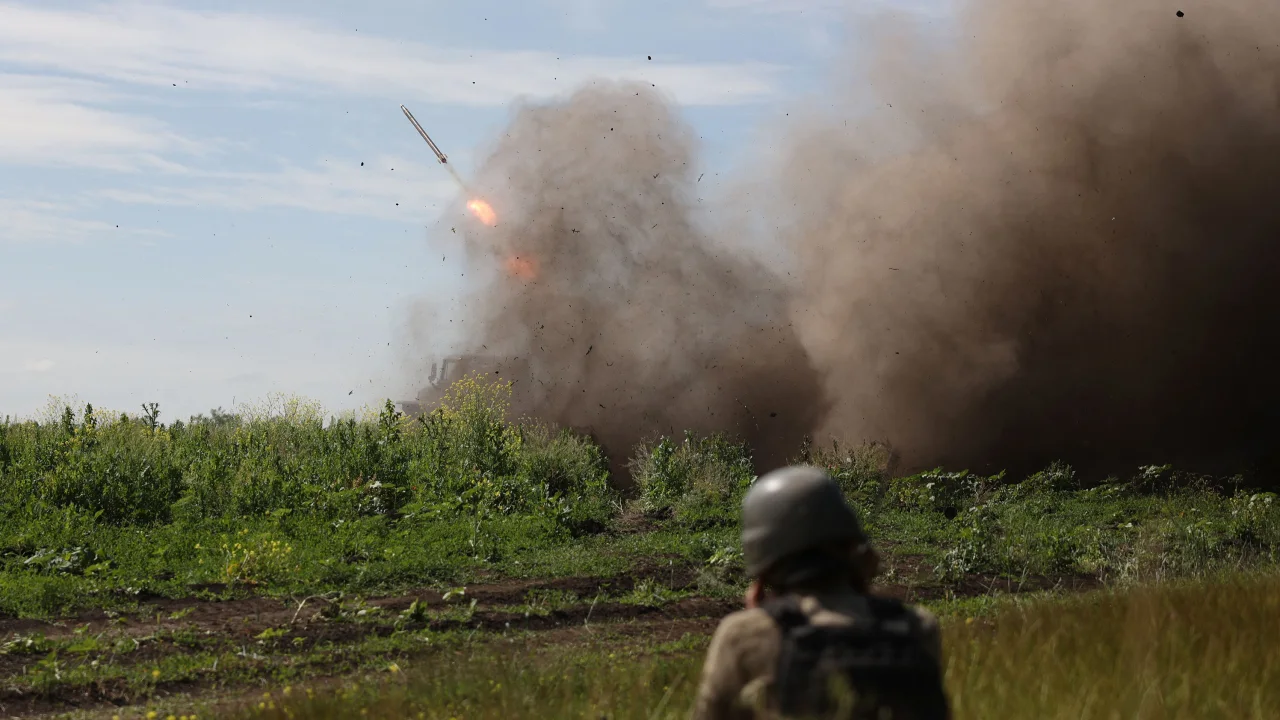
Ukraine’s counteroffensive against Russian forces has not yet gained the momentum that some overly optimistic observers anticipated. So far it feels like the prelude to a more expansive act.
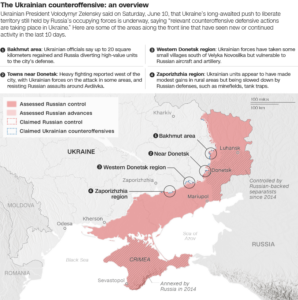
Offensive operations so far have yielded modest gains in the southern regions like Zaporizhzhia with multi-layered Russian defenses proving tough to crack. The area is seen as a major target for Ukraine as it would mean breaking Russia’s land bridge between annexed Crimea and eastern Donetsk.
On Thursday, an adviser to the head of Ukrainian President Volodymyr Zelensky’s office, Mykhailo Podolyak, said the first goal was to wipe out as many Russian draftee units as possible and “increase the psychological pressure on the Russian army.”
“At the same time,” he said, Ukrainian units are “testing to see which areas are the weakest.”
This has included fresh assault operations around Bakhmut designed to force the Russians to send more units to defend a city they took more than six months to destroy and occupy. On Friday, the commander of Ukrainian Land Forces, Oleksandr Syrskyi, said the Russians “continue to move some of the most combat-ready units to the Bakhmut direction.”
Perhaps more surprisingly, there are indications that the Ukrainians are on the front foot near the city of Donetsk, long a frozen line of contact, and further south around what has been the equally static but highly kinetic Vuhledar front.
The Ukrainians have the luxury of picking areas to attack; the Russians must try to defend a meandering front line nearly 1,000 kilometers (621 miles) long, with some units that have already been mauled and patched up.
Still, it is a formidable task: in the south especially, Ukrainian forces must conduct a frontal assault against deeply prepared defensive positions, and critically they lack air superiority. The Russians have had months to fortify defenses here; there was never a chance that the Ukrainians would make the sort of lightning advances they enjoyed in Kharkiv last fall.
The Institute for the Study of War also cautions that it’s far too early for takeaways.
“Ukraine has not yet committed the vast majority of its counteroffensive forces and Russian defenses are not uniformly strong along all sectors of the front line,” it said this week.
Matthew Schmidt, associate professor of national security at the University of New Haven, agrees there are more questions than answers at this early stage.
“Are the Russians reacting strategically? Are they moving troops and supplies as though they see the current focus of the fighting as the main thrust?” he says.
“Only a quarter or so of the total Ukrainian force is apparently engaged, what are the rest doing? Are the Russians confused about where they’ll be used?”
The Ukrainians will be hoping that the Russian military command under Chief of Staff Valery Gerasimov, now in direct command of forces in Ukraine, will get some calls wrong.
As Mick Ryan, a former general in the Australian armed forces observes: “There is an old saying that ‘when your enemy is making mistakes, don’t get in their way’. For some time, Gerasimov has shown an aptitude for making strategic mistakes,” not least with the ill-conceived initial assault in February 2022.
So far the Russian approach to defending their lines in the south appears to have worked relatively well, with the Ukrainians losing mine-clearing tanks and other armor that have become prey to artillery and aerial attack as they try to break through. Available open-source video suggests high use of anti-tank munitions is taking a toll on Ukrainian front-line units.
“A first [Russian] echelon of forces repels or slows attacking forces before a second echelon of forces counterattacks against any enemy breakthrough,” says the Washington-based Institute for the Study of War (ISW).
One Ukrainian officer has acknowledged the challenge, writing that “While obstacles can be effectively bypassed using mine-clearing vehicles, bulldozers, mine plows, and other engineering equipment, it becomes challenging to do so with the presence of drones” which provide real-time data to enemy artillery and aviation.
It’s worth noting that Russian units in one heavily-contested area – belonging to the 58th Combined Arms Army – are among the most effective in the military.